

23 Points of Failure
Securing the Modern Enterprise by Eliminating 23 Critical Points of Failure
Mitigating points of failure and minimizing potential network breach areas of attack before they happen
First published March 2019, Ron Lovern
As digital transformation accelerates, organizations face an expanding attack surface driven by cloud adoption, remote work, and distributed applications. Traditional, single-site, hierarchical network designs no longer provide adequate visibility, control, or security.
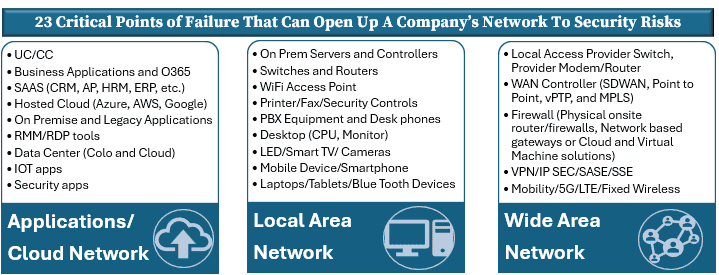
Building an End-to-End Network Security Solution requires a fully integrated, secure managed services platform that seamlessly integrates application, infrastructure, network and business communication services. Mitigating and preventing a potential local area network (LAN), wide area network (WAN), application, cloud and virtual network (ACVN) security breach across an organization’s environment starts with building an end-to-end view of the communication stack. This process starts with establishing a network and communication framework built to address 23 distinct points of failure in a business’ network stackAs businesses become more distributed and cloud-dependent, addressing security gaps in isolation is no longer effective. This use case demonstrates how an end-to-end network security strategy, built around identifying and mitigating 23 critical points of failure, enables organizations to protect their networks, empower their workforce, and sustain growth in an increasingly hostile threat environment. Securing the modern enterprise focuses on eliminating gaps and potential points of failure between the local area network (LAN), wide area network (WAN), and Cloud/Application network and infrastructure.
23 Points of Failure Framework
Key areas of potential breach-points can be defined within at least 23 points of failure that every business should be addressing
- These areas consist of 3 distinct parts of the network
- LAN, WAN, and Virtual (Cloud and Application)
- Today's Communication Framework needs to be able to effectively address each of these areas of today’s network
- As we rely more on technology for success and growth, the importance of security also increases,
- As more businesses migrate to the cloud, the need for real-time protection continues to grow.
- Business continuity and disaster recovery should be included as part of daily business communications functionality
- Establishing a fully manageable and secure business network platform seamlessly is critical in today’s business environment
- As we continue to move toward a more mobile and remote work force, Companies must be able to effectively manage communication resources while avoiding catastrophic threats to the health of their network
Digital Transformation is Imperative Today
A digital transformation strategy is no longer a luxury of business.
- It is imperative that all companies, business owners and leadership work to mitigate potential points of failure within their network design
- Data-driven businesses must have resilient and agile IT that facilitates innovative, flexible work and supports remote
- Daily cyber-attacks on business have become all too commonplace
At the same time, employees have different expectations about technology.
- Today’s employees expect technology to work in ways that fit their professional needs and individual preferences
- As a result, organizations of all sizes are no longer able to manage their communications network in a single site hierarchical fashion
- Gone too are the days when computing centered around data processing, storage, and compute power housed in a data center
- Employees at all levels share ideas across various communication platforms within their company
- Collaboration tools and business intelligence platforms are often spread out over unsecured networks no longer controlled securely within a company’s IT management
End to End Security Solution
An End-to-End Network Security Solution provides ability to possess the knowledge needed and effectively manage the communications network infrastructure by providing an end-to-end view across a customer’s entire communications framework.
- A fully managed network and infrastructure view provides valuable data and information across customer network, infrastructure, communication resources and applications within a fully secured managed environment.
- This extends your ability to manage LAN, WAN, and Virtual network environments beyond the firewall.
- Providing a true framework for eliminating critical points of failure within the customer environment.
Summary
While expectations about technology and technology itself have changed in recent years, the newer shifts are being shaped by demographics. Today’s employees that make up much of the workforce value flexibility and mobility. These employees are adept at using applications and technology in their personal lives, and they expect the same capabilities in their work lives.
Employees need to collaborate in real time and rely on company data to create secure connectivity to allow engaging content, run deep analytics, build visualizations, and share ideas across the organization. Employees access apps on the web and as well as mobile devices, which means they are no longer dependent on the traditional workplace environment to get their work done. Today's Communication Framework needs to be able to effectively address each of the 23 points of failure areas within their network.
23 Points of Failure - Use Case Study
Customer Profile
- Organization Type: Mid-to-large enterprise
- Environment: Hybrid workforce (on-site, remote, mobile users)
- IT Landscape: LAN, WAN, cloud applications, collaboration platforms
- Primary Concern: Increasing cybersecurity risk and lack of visibility across the network
Business Challenge
Employees expect seamless connectivity, and modern technology solutions with success in powerful operating systems and a full range of applications. Employees at all levels share ideas and work collaboratively on projects. Today, applications powered by artificial intelligence and machine learning drive business intelligence and are the foundation for innovation. As business continues to move toward a more disparate workforce, the company must be able to effectively secure their business network with an end-to-end managed network security solution
The customer was experiencing:
- Limited end-to-end visibility across LAN, WAN, and cloud environments
- Increased exposure to cyber threats across multiple unmanaged access points
- Fragmented communication and collaboration platforms
- Difficulty managing security consistently for remote and mobile employees
- Growing risk of business disruption due to unaddressed points of failure
Daily cyberattacks and the decentralization of IT resources made it clear that existing security models were no longer sufficient.
Solution Overview
The organization adopted an End-to-End Network and Communication Security Framework designed to identify, manage, and mitigate 23 distinct points of failure across the enterprise network.
The solution focused on:
- A holistic, end-to-end view of the entire communication stack
- Integrated security across LAN, WAN, and Virtual (Cloud/Application) environments
- Cloud-based, managed network security services
- Real-time threat protection and monitoring
- Secure enablement of collaboration, mobility, and remote access
Rather than treating security as a perimeter-only function, the framework extended protection beyond the firewall, ensuring visibility and control across all users, devices, and applications.
Architecture & Key Components
- LAN Security
- Endpoint access control
- Internal traffic monitoring
- Segmentation to limit lateral movement
- WAN Security
- Secure connectivity between sites
- Encrypted traffic flows
- Centralized policy enforcement
- Virtual & Cloud Security
- Application-level protection
- Secure access to cloud services
- Visibility into collaboration and business intelligence platforms
- Centralized Management
- End-to-end visibility of the communication framework
- Actionable data for proactive network management
- Unified control across physical and virtual environments
Business Outcomes
By addressing all 23 potential points of failure, the organization achieved:
- Reduced Security Risk: Minimized exposure to network breaches across all environments
- Improved Visibility: Full end-to-end insight into network and communication flows
- Stronger Business Continuity: Security embedded into daily operations and disaster recovery planning
- Workforce Enablement: Secure, seamless connectivity for remote and mobile employees
- Operational Efficiency: Simplified management of a complex, distributed network
Key Value Delivered
- Security aligned with modern digital transformation initiatives
- A resilient, agile IT foundation supporting data-driven business operations
- Protection designed for today’s collaboration-heavy, cloud-first workforce
- A scalable framework that evolves with technology and business growth
Conclusion
As businesses become more distributed and cloud-dependent, addressing security gaps in isolation is no longer effective. This use case demonstrates how an end-to-end network security strategy, built around identifying and mitigating 23 critical points of failure, enables organizations to protect their networks, empower their workforce, and sustain growth in an increasingly hostile threat environment.
1. Mapping to the NIST Cybersecurity Framework (CSF)
NIST CSF Core Functions: Identify, Protect, Detect, Respond, Recover
IDENTIFY
NIST Categories: Asset Management, Risk Assessment, Governance
Solution Alignment
- End-to-end visibility across LAN, WAN, and Virtual (Cloud/App) environments
- Identification of 23 distinct points of failure within the communication framework
- Continuous understanding of users, devices, applications, and data flows
- Risk awareness driven by centralized network intelligence
Value
- Eliminates blind spots across distributed and remote environments
- Enables proactive risk mitigation instead of reactive security
PROTECT
NIST Categories: Access Control, Data Security, Protective Technology
Solution Alignment
- Secure access to applications and data regardless of user location
- Network segmentation and policy-based controls across all environments
- Encryption and secure connectivity across WAN and cloud services
- Protection extends beyond the firewall to users, devices, and apps
Value
- Consistent security enforcement across all 23 points of failure
- Reduced attack surface in hybrid and cloud-first environments
DETECT
NIST Categories: Anomalies and Events, Continuous Monitoring
Solution Alignment
- Real-time monitoring of network traffic, applications, and user behavior
- Visibility into collaboration platforms and cloud-based workloads
- Continuous insight across LAN, WAN, and Virtual networks
Value
- Faster identification of threats and abnormal activity
- Reduced dwell time of attackers inside the network
RESPOND
NIST Categories: Response Planning, Mitigation, Communications
Solution Alignment
- Centralized control for rapid containment of threats
- Policy-driven response actions across the entire communication stack
- Coordinated response across network, cloud, and application layers
Value
- Faster, more consistent incident response
- Reduced operational disruption
RECOVER
NIST Categories: Recovery Planning, Improvements
Solution Alignment
- Security embedded into business continuity and disaster recovery planning
- Rapid restoration of secure connectivity and services
- Continuous improvement through insights gained from incidents
Value
- Increased resilience and uptime
- Stronger post-incident posture
2. Mapping to Zero Trust Architecture
Zero Trust Principle: Never trust, always verify
Core Zero Trust Tenets
1. Verify Explicitly
Alignment
- Continuous validation of users, devices, and applications
- Security decisions based on identity, location, and behavior
- Visibility into all access paths across the 23 failure points
2. Use Least Privilege Access
Alignment
- Granular access controls across LAN, WAN, and cloud
- Segmentation to limit lateral movement within the network
- Application-specific access rather than broad network access
3. Assume Breach
Alignment
- Continuous monitoring and real-time threat detection
- Design assumes compromise and limits blast radius
- End-to-end visibility enables rapid isolation of threats
Zero Trust Pillars Supported
- Identity: User and device awareness
- Device: Secure access from managed and unmanaged endpoints
- Network: Segmentation and encrypted connectivity
- Application: Secure, policy-driven app access
- Data: Protected data flows across environments
Zero Trust Outcome
- All 23 points of failure are treated as potential breach points and continuously controlled
3. Mapping to SASE (Secure Access Service Edge)
SASE Objective: Converge networking and security into a cloud-delivered service
Core SASE Components
Secure Networking
Alignment
- Cloud-based WAN connectivity
- Secure access for branch offices, remote users, and mobile workers
- Centralized policy enforcement
Security Services
Alignment
- Integrated threat protection across network and cloud
- Consistent security policies regardless of user location
- Protection for collaboration and SaaS platforms
Identity-Driven Access
Alignment
- User-centric security model rather than location-based
- Secure application access from anywhere
- Policies enforced at the cloud edge
Centralized Management
Alignment
- Single-pane-of-glass visibility into the full communication framework
- Unified control across LAN, WAN, and Virtual networks
- Simplified operations and reduced complexity
SASE Business Value
- Enables secure remote and hybrid work
- Reduces reliance on traditional perimeter-based security
- Aligns networking and security with modern digital transformation